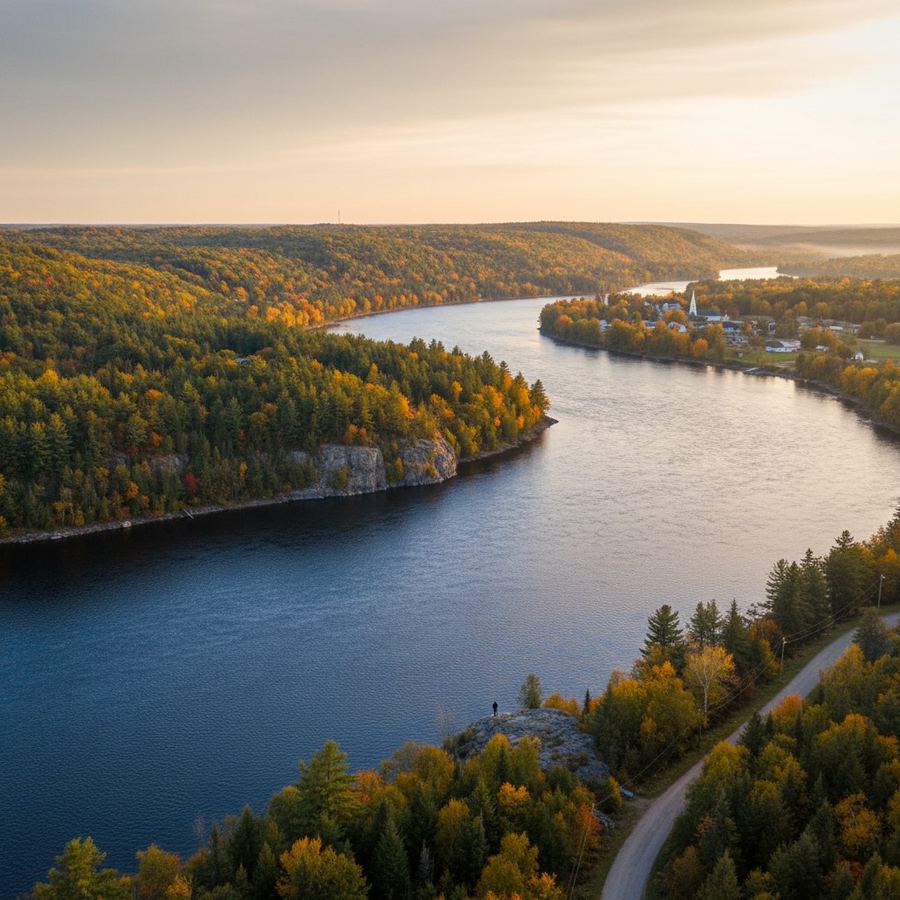
The Ottawa River is one of the longest in Ontario, and the valley it cuts through the Canadian Shield is one of the least-visited parts of southern Ontario. Highway 17, the Trans-Canada, follows the river's south bank from Arnprior to Deep River, passing through a string of small towns where the accent is distinct, the logging history runs deep, and the pace is genuinely slower than anywhere within commuting distance of Toronto. This is not cottage country in the Muskoka sense. The Ottawa Valley is a working landscape of farms, forests, and military communities, and that is a large part of why people who know it keep coming back.
Arnprior and Renfrew
Arnprior, population around 9,000, sits where the Madawaska River meets the Ottawa. It is the eastern gateway to the Valley if you are coming from Ottawa, about 60 km west on Highway 17. The downtown has a cluster of restaurants and shops along John Street, and the Arnprior and District Museum covers the town's lumber-baron past. Gillies Grove, a patch of old-growth white pine on the edge of town, is one of the few remaining stands of the trees that built the Ottawa Valley's timber economy.
Renfrew, 30 km further west, is the commercial centre of the upper Valley with a population of about 8,500. The O'Brien Theatre, a refurbished 1920s movie house, hosts films and live performances. Renfrew's Swinging Bridge, a pedestrian suspension bridge over the Bonnechere River downtown, is a local landmark. The town has the services you need for a base camp: grocery stores, a hospital, motels, and a handful of decent restaurants.
Petawawa and CFB Petawawa
Canadian Forces Base Petawawa is the dominant presence in this part of the Valley. The base, one of the largest military installations in Canada, has been operating since 1905 and is home to roughly 6,000 military personnel. The town of Petawawa, adjacent to the base, has a population of about 18,000 and the feel of a community built around a single employer. That means good infrastructure, well-maintained roads, and a Tim Hortons on every block, but also the transient character that comes with regular postings and rotations.
Petawawa Point, where the Petawawa River meets the Ottawa, has a beach and park area that is popular in summer. The town serves as a useful stopping point for anyone heading to Algonquin Park's east side. For local details, petawawa.com covers community events and services in the area.
Pembroke and the Upper Valley
Pembroke, population roughly 14,000, is the largest town in the upper Ottawa Valley and the seat of Renfrew County. It sits where the Muskrat River flows into the Ottawa, and the murals painted on downtown buildings tell the story of the Valley's Indigenous, logging, and farming heritage. There are over 30 of them, and they are worth a slow walk through the commercial core.
North and west of Pembroke, the Valley becomes increasingly rural. Deep River, about 60 km further on Highway 17, is a small community originally built for staff at the Chalk River Laboratories, the nuclear research facility where Canada's nuclear program began. The town has an oddly cosmopolitan character for its size, a legacy of decades of international scientists living in a village of 4,000.
Bonnechere Caves and Natural Attractions
The Bonnechere Caves, near Eganville about 30 km south of Pembroke, are limestone caverns carved by an ancient tropical sea roughly 500 million years ago. Guided tours run May through October. It is a good family outing and genuinely interesting geology, not a kitschy roadside attraction.
The Ottawa River itself is the region's biggest recreational draw. Whitewater rafting near Foresters Falls, about 20 km west of Pembroke, has operated commercially since the 1980s. Outfitters run half-day and full-day trips on Class III and IV rapids from May through September.
Barry's Bay and the Algonquin Edge
South of the Valley proper, Highway 60 leads to Barry's Bay and the eastern approaches to Algonquin Provincial Park. Barry's Bay, population about 1,300, is a Polish-Canadian community with a distinct cultural identity, visible in the local churches and the Wilno Heritage Park, which commemorates the first Polish settlement in Canada. The town is a supply stop for canoeists heading into Algonquin's eastern interior and a quieter alternative to Huntsville for Algonquin access.
Getting There
From Toronto, the Ottawa Valley is roughly a four-hour drive depending on your destination. Highway 401 east to Highway 7 through Perth and Carleton Place is one route; Highway 400 north to Highway 11, then east on Highway 60 through Algonquin is another, slower but more scenic option. From Ottawa, Arnprior is just 60 km west on Highway 17. The Valley is a long, linear region, so plan your stops in advance rather than trying to see everything in a single trip.
Explore More
Petawawa
The military town at the centre of the Valley. Base life, river access, and practical services.
Eastern Ontario
The broader region south of the Valley, from Brockville to the Rideau Canal corridor.
Small Towns Worth Visiting
Valley towns like Renfrew and Pembroke alongside others across southern Ontario.